
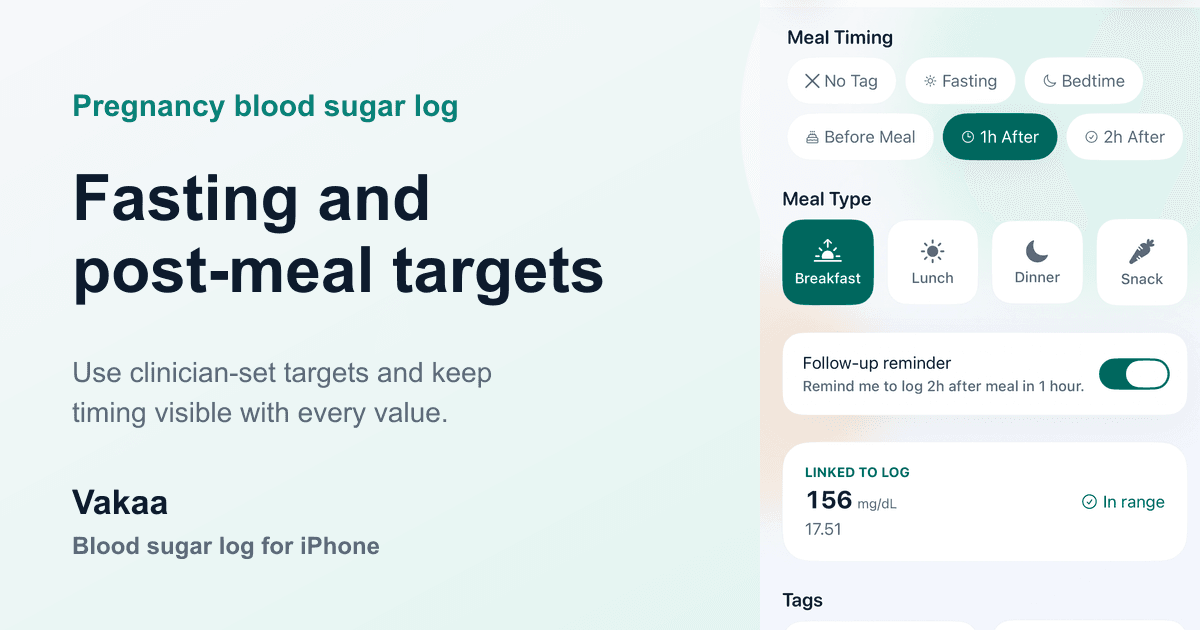
A blood sugar log for pregnancy has one job: make the pattern clear enough for your obstetric care team to review. That usually means separating fasting readings from post-meal readings and keeping the unit visible next to every value.
The log itself does not decide whether a reading is acceptable for you. Pregnancy targets can vary by clinician, country, pregnancy history, medication plan, and hypoglycemia risk. The safest log is the one that records the facts clearly and leaves interpretation to your care team.
Why pregnancy logs focus on timing
Fasting and post-meal readings are not interchangeable. A fasting value is usually recorded after the overnight period and before breakfast. A post-meal value is recorded after food, often at a specific one-hour or two-hour point.
When the timing is missing, the same number becomes harder to understand. A reading written as “132 mg/dL” may be in a very different context if it was fasting, one hour after breakfast, or two hours after dinner. A good pregnancy log keeps those labels visible.
The companion article on a gestational diabetes log walks through the common four-check routine. The free printable blood sugar log template includes a gestational layout if you want a paper version.
Target examples need a source
For medical numbers, use a real source and then follow your clinician’s plan. The
NICE diabetes in pregnancy guideline
lists target examples for pregnant people testing blood glucose. NICE gives these examples in
mmol/L:
| Timing | NICE target example | Approximate mg/dL equivalent |
|---|---|---|
| Fasting | Below 5.3 mmol/L | Below about 95 mg/dL |
| 1 hour after meals | Below 7.8 mmol/L | Below about 140 mg/dL |
| 2 hours after meals | Below 6.4 mmol/L | Below about 115 mg/dL |
Those are examples from one guideline, not a personal care plan. NICE also notes that targets may need individual adjustment when hypoglycemia risk is a concern. The CDC gestational diabetes overview also points people back to their health care team for monitoring and management.
Why the unit must be written every time
Pregnancy logs often get shared: screenshots, paper sheets, portal uploads, or photos sent before an appointment. Unit ambiguity creates avoidable confusion.
In the United States, many meters and apps show mg/dL. In the United Kingdom, Canada, Australia,
and many other countries, mmol/L is common. The numbers look completely different. For example,
5.3 mmol/L is about 95 mg/dL, while 95 mmol/L would not be a routine blood glucose entry.
This is also why reports should not hide units in a table header that disappears when someone takes a screenshot. Put the unit close to the value, repeat it in exported summaries, and keep the same unit throughout a single report unless your clinician asks for both.
If you ever convert units, use the formula carefully: mg/dL = mmol/L x 18. The conversion article
has a larger mmol/L to mg/dL chart for common
manual log values.
How to write a clear row
A clear pregnancy log row usually includes:
- value and unit, such as
118 mg/dLor6.6 mmol/L - date and time
- timing label, such as fasting, 1h after breakfast, or 2h after dinner
- target from your clinician, if they asked you to compare on the sheet
- short note only when relevant
That is enough for a readable record. You do not need to add a long note to every row unless your care team specifically asked for a food diary, medication log, or symptom notes.
What about high or low readings?
Avoid judging the reading in the log. A logbook is a record, not a grade. Use neutral labels such as “above target” or “below target” if your clinician gave you target ranges. If you have symptoms, urgent readings, or medication questions, use the instructions from your care team rather than a blog post.
This language matters. Pregnancy already carries enough pressure. A useful log gives your clinician the facts without turning every number into a personal verdict.
Paper vs iPhone
Paper works well when the goal is a simple weekly sheet. It is easy to print, mark up, and bring to an appointment. The limitation is that paper does not filter, summarize, or pair readings automatically.
An iPhone logbook helps when you want timestamps, reminders, paired before-and-after meal context, and cleaner summaries. Vakaa keeps the workflow intentionally narrow: value, time, unit, meal timing, and optional notes. It is not a glucose monitor and does not measure blood sugar.
If you are starting from scratch, print the blood sugar log template or read the general guide to keeping a blood sugar log on iPhone. Then use whichever format you can keep consistently.
A simple target-safety checklist
Before relying on a pregnancy blood sugar log, confirm these details with your clinician:
- Which unit should the log use:
mg/dLormmol/L? - Should post-meal readings be checked at one hour or two hours?
- Which fasting and post-meal targets apply to you?
- What should you do if readings are outside the target range?
- How many days or weeks of logs should you bring to appointments?
The answers make the log much more useful. The app or paper sheet should then get out of the way and help you record those facts consistently.